
 (844) 230-7676
 Language

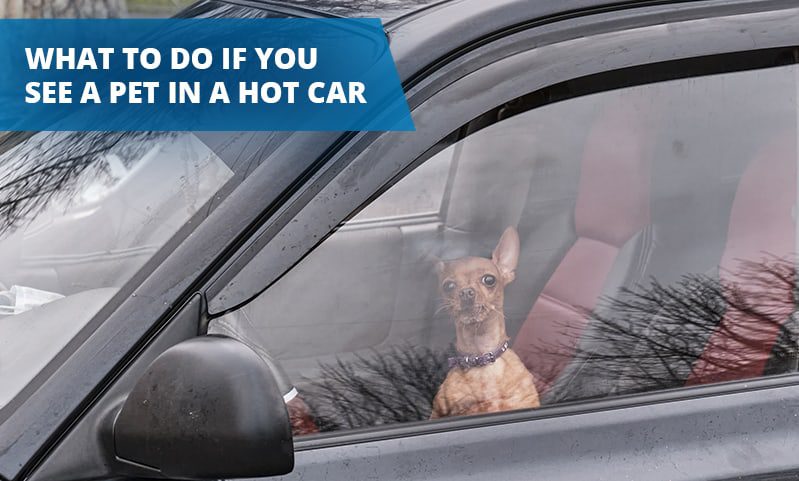
Many people feel comfortable leaving their pets unattended in their vehicles because they’ll just be gone for a few minutes. However, even with the windows cracked, inside temperatures can exceed outside temperatures by 30 degrees in twenty minutes. As a result, several hundred animals suffocate in hot cars every year.
Tesla, Rivian, and a few other newer EV models keep climate controls on and pets cool while parked. Some Hyundais, Subarus, and Nissans have rear occupant alerts that sound alarms if they detect movement inside a vehicle after the driver locks the car. This feature is designed to protect children, but it could protect pets as well.
Beginning in 2025, these alerts will be standard features in most new cars sold in the United States.
Helping Animals in Hot Cars
Section 353(d) of the New York Agricultural and Markets Code gives “a police officer, peace officer, peace officer acting as an agent of a duly incorporated humane society, emergency medical services personnel, paid firefighter, or volunteer firefighter” the power to “take necessary steps to remove the animal or animals from the vehicle.”
This law also includes a Good Samaritan provision. These laws shield emergency intervenors from liability if they cause damage, like smashing car windows, during the performance of their lawful emergency powers.
Neither the emergency powers nor the Good Samaritan protection applies to non-emergency responders. Legally, if you see an animal in a hot car in New York, the only action you can take is to call 9-1-1.
This law puts many people in an uncomfortable position. Emergency responders often don’t spring into action over a report of a pet in a hot car. Many states extend emergency powers, and often Good Samaritan protection as well, to non-emergency responders in these situations. New York isn’t one of these jurisdictions.
Furthermore, a passer-by doesn’t know if the animal has been in the car for fifteen minutes or fifteen seconds.
Nevertheless, it’s hard to call for help and then do nothing in these situations.
Helping People at Accident Scenes
In contrast, if the possibly injured party is a human, emergency intervention is not just an option, it’s mandatory.
After a car accident, all parties to the crash, regardless of accident fault, have a legal responsibility to:
- Call for help,
- Assist injured victims if possible,
- Wait for that help to arrive,
- Exchange insurance information with the other drivers, and
- Remain at the scene until released.
This requirement is broader than it is in other states. For example, many states don’t require accident parties to exchange personal information, at least in some cases. But New York has a no-fault insurance law which makes this exchange of information necessary.
People in these situations don’t have to worry about damaging property, like breaking into a car to free a pinned victim. They also don’t have to worry about moving a victim with a back injury or otherwise making a personal injury worse.
Partial assistance situations and well-intentioned injuries are in a gray area. In a scenario where an attempt to help someone leads to their injury, the one helping might be legally responsible for the harm.
Car Accident Compensation
This legal responsibility includes paying compensation for those injuries. Compensation for a deceased pet is usually minimal. In most cases, New York law limits compensation in these cases to the animal’s fair market value, which is usually little or nothing. Compensation in a personal injury case is much higher.
These victims are entitled to money for economic losses, such as medical bills, and noneconomic losses, such as pain and suffering. A personal injury attorney can obtain additional punitive damages as well, in some extreme cases.
Compensation could be available even if, as mentioned above, an insurance investigator or emergency responder said you were at fault for the wreck. Preliminary investigations don’t always produce accurate results. Additionally, legal doctrines often come into play, such as comparative fault.
Injury victims can be entitled to substantial compensation. For a free consultation with an experienced personal injury attorney, contact Napoli Shkolnik. We do not charge upfront legal fees and only recover a fee when we win your case.