
 (844) 230-7676
 Language

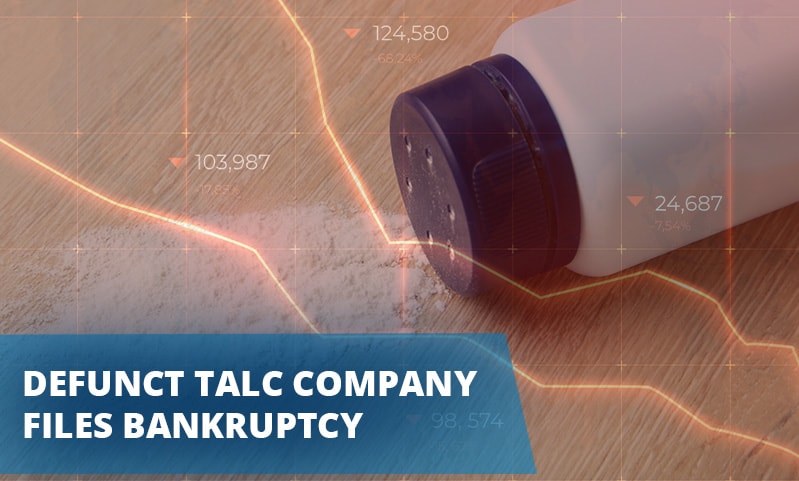
To avoid a deluge of liability lawsuits, Whittaker, a major talc supplier, closed its doors in 2004 and filed Chapter 11 bankruptcy. More than 2,700 individuals have sued Whittaker alleging its talc products exposed them to asbestos. Whittaker said that it was forced to seek bankruptcy protection after a recent $29 million verdict in South Carolina, when a judge appointed a receiver to take over its operations. The company argues that its assets should be equitably distributed among all talc claimants rather than being seized by the receiver. Litigation has driven other talc suppliers into bankruptcy in recent years, including Cyprus Mines and Imerys Talc. Johnson & Johnson is currently attempting to resolve its talc liabilities through the bankruptcy of a subsidiary company, LTL Management.
Talc/Asbestos
Talc-related cancer issues aren’t limited to providers. For many years, miners faced similar risks. The talc on store shelves is refined powder. Underground, this mineral, one of the softest ones on earth, is fibrous. Asbestos is fibrous as well, but it’s also toxic. Frequently, asbestos mines are near to, or even adjacent to, talc mines. So, cross-contamination is common, especially when workers come and go. Asbestos miners, at least until asbestos mining was banned in the United States in 2002, generally wore protective clothing and adhered to rigid safety handling rules. Wearing protective clothing to mine talc is not common. A single stray asbestos fiber could cause mesothelioma or another serious and potentially fatal illness. Product cross-contamination is common as well. Asbestos fibers commonly float into talc extraction or collection areas. In 2019, Claire’s voluntarily recalled asbestos-tainted makeup. Three samples from Claire’s, and one from Justice, tested positive for asbestos. Incidentally, a voluntary recall does nothing to compensate asbestos exposure victims. Only a skilled attorney can do that.
Talc/Cancer
This substance has been linked to lung cancer among talc miners and ovarian cancer among talc users. Talc is not a toxic substance, so it’s not as dangerous as asbestos when inhaled. But talc is a foreign substance that the body cannot easily dispose of. As a result, it often causes tumors to form in the lungs. Many talc/lung cancer victims have no obvious genetic, lifestyle, or other risk factors. As a result, when they see their doctors complaining of pain, fatigue, weight loss, and other initial cancer symptoms, many doctors diagnose the patient with something like chronic fatigue syndrome. So, their tumors grow and most likely spread through the body. Researchers speculate that talc fibers cause ovarian cancer when those fibers migrate from the genitals to the ovaries through the fallopian tubes.
Your Legal Options
A failure to warn (FTW) doctrine can be used to obtain compensation. FTW is a negligence case, the elements of which are:
- Duty: Retailers like Claire’s and wholesalers like Whittaker Clark & Daniels have a duty to warn customers about all known product risks. Additionally, the warning must match the risk.
- Breach: Companies breach their duty of care when their behavior falls below the standard of care. For this reason, many attorneys partner with expert witnesses who establish the standard of care in court.
- Cause: This issue is usually the most hotly-contested issue in a talc/cancer case. As mentioned, the standard of proof is low. However, defendants invariably use testimony from “experts” who conclude that a dangerous product is safe.
- Damages: Damages in a personal injury case usually include compensation for economic losses, such as medical bills, and noneconomic losses, such as pain and suffering. Additional punitive damages are usually available in these cases as well.
Many asbestos exposure cases are defective product claims. Generally, companies are strictly liable for injuries their defective products cause. There’s no need to prove negligence in these cases. Other options are available as well. For example, if the asbestos exposure was work or service-related, a victim can usually file a workers’ compensation or VA disability claim. Injury victims are entitled to substantial compensation. For a free consultation with an experienced attorney, contact Napoli Shkolnik. We routinely handle matters on a nationwide basis.