
 (844) 230-7676
 Language

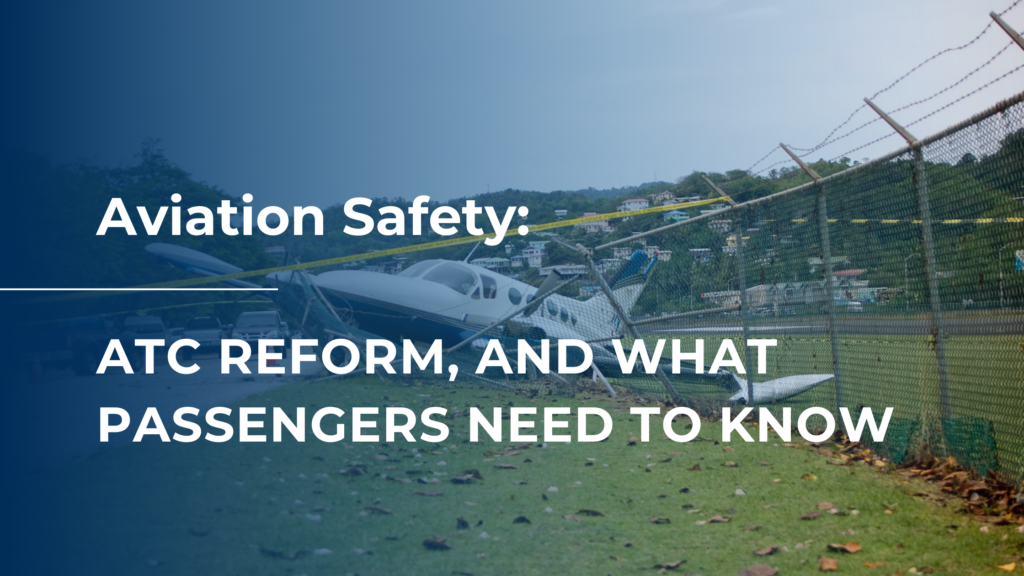
As global air travel reaches record highs, scrutiny intensifies over aviation safety, FAA oversight, and legislative efforts to modernize U.S. airspace.
The airline industry is on track to carry a record 5.2 billion passengers worldwide, a 6.7% increase from 2024. The rebound from the COVID-19 slowdown has been dramatic, with global fleets expanding and flight schedules approaching (and in many markets exceeding) pre-pandemic levels.
Yet alongside this growth, aviation safety has come under renewed scrutiny.
A series of high-profile fatal accidents has raised difficult questions about U.S. aviation safety, Federal Aviation Administration (FAA) oversight, air traffic control (ATC) staffing, aircraft manufacturing standards, and military-civilian airspace coordination. While aviation remains statistically one of the safest modes of transportation, recent developments highlight the complex, multi-layered systems required to keep millions of passengers safe every day.
Aviation Fatalities: What the Numbers Show
In 2025, 548 people died in aircraft accidents worldwide, marking a more than 30% increase over 2024, when 404 aviation fatalities were recorded. According to aviation safety databases, the 2025 total was the highest since 2018, when 962 people died in air crashes.
Importantly, safety data shows that while fatalities increased, the total number of aviation incidents declined. That distinction matters. The increase was not driven by a dramatic rise in accident frequency, but by the severity of several major crashes.
The COVID-19 pandemic also created a statistical anomaly. During 2020 and much of 2021, global lockdowns and stay-at-home orders resulted in dramatically fewer flights. With fewer aircraft in the air, the total number of accidents and fatalities dropped accordingly. As flight volumes surged back in 2023, 2024, and 2025, raw fatality totals rose, though safety rates per flight hour remain a key metric for regulators.
Still, perception matters. And in recent years, perception has been shaped by several catastrophic events.
The Air India Crash in Ahmedabad and Renewed Pressure on Boeing
The deadliest aviation accident of 2025 occurred in Ahmedabad, India, involving an Air India aircraft that killed 241 passengers and 19 people on the ground. While the crash did not take place in the United States, it once again intensified scrutiny of U.S. aircraft manufacturer Boeing, as the aircraft involved was a 787 jet.
For Boeing, which has faced years of regulatory investigations, production delays, and safety controversies, the crash renewed global debate about manufacturing oversight and certification processes. Although investigations are ongoing and aviation accidents rarely result from a single cause, the incident underscored how global aviation safety is interconnected.
Aircraft are designed, manufactured, maintained, inspected, and operated across multiple countries and regulatory frameworks. A failure in one part of the system can reverberate worldwide.
U.S. Aviation Safety Under the Microscope
Questions about aviation safety have not been limited to international events. In January 2025, a tragic midair collision between an American Airlines regional jet and a U.S. Army Black Hawk helicopter near Reagan Washington National Airport killed 67 people.
The collision prompted a year-long investigation and generated 50 aviation safety recommendations. A bipartisan group of U.S. House lawmakers subsequently introduced legislation aimed at addressing:
- Deficiencies in FAA safety culture
- Enhancing air traffic control training and procedures
- Strengthening safety in complex airspace near Washington, D.C.
- Improving coordination between civilian and military aviation
The incident highlighted vulnerabilities in shared airspace and reinforced longstanding concerns about air traffic control staffing shortages and aging infrastructure.
LaGuardia Runway Collision, March 2026: Aviation Attorney Hunter J. Shkolnik Shares His Expertise
On March 23, 2026, Air Canada Express Flight 8646, which was landing in New York from Montreal, collided with a Port Authority fire truck at LaGuardia Airport, killing both pilots, Captain Antoine Forest and First Officer Mackenzie Gunther, and injuring over 40 people.
Partner Hunter J. Shkolnik was on LiveNOW from FOX and FOX 5 New York to share his legal aviation expertise and address key legal questions emerging from the investigation: what may have caused the crash, who could bear responsibility, and what victims and families should know.
The runway warning system failed to sound an alarm, plus the firetruck did not have a transponder, which is a problem for all vehicles at LaGuardia and other NY airports. This seems to have been human failure in the tower, a system failure with equipment, and most New York airports are overcrowded, and air traffic controllers are overworked.
“We were able to see people walk away from a crash like this. This is a tragedy, but it could have been a lot worse, and these pilots gave up their lives to save the rest of those passengers,” shared Mr. Shkolnik.
FAA and Air Traffic Control: Aging Systems and Staffing Challenges
The U.S. air traffic control system has long been considered one of the most complex in the world. However, critics argue it is also increasingly strained.
Understaffing within ATC has been widely reported, and experts say shortages can increase controller workload, reduce redundancy, and heighten risk in already congested airspace. In May 2025, U.S. Transportation Secretary Sean Duffy unveiled plans for a new, modernized ATC system in response to identified failings.
Modernization efforts are expected to include:
- Updated radar and surveillance technology
- Enhanced digital communications systems
- Improved controller training
- Greater integration of real-time data tools
As flight volumes rise toward record levels, the need for resilient, well-funded airspace management systems becomes increasingly urgent.
The ROTOR Act vs. the ALERT Act: A Legislative Divide
In response to the January 2025 collision, lawmakers introduced the Rotorcraft Operations Transparency and Oversight Reform Act, known as the ROTOR Act. The legislation would require aircraft operators to equip their fleets with Automatic Dependent Surveillance-Broadcast (ADS-B) technology by the end of 2031.
ADS-B is a surveillance system that broadcasts an aircraft’s precise location, altitude, and velocity in real time, improving situational awareness for both pilots and controllers.
The ROTOR Act passed the U.S. Senate unanimously in December but failed to secure the two-thirds majority required for fast-track passage in the House. The final vote was 264-133.
Opposition intensified after the U.S. Department of Defense raised concerns. The Pentagon argued that mandatory ADS-B use could create “significant unresolved budgetary burdens and operational security risks affecting national defense activities.”
In response, some House Republicans advanced an alternative proposal: the Airspace Location and Enhanced Risk Transparency (ALERT) Act. Supporters said the ALERT Act was more closely aligned with recommendations issued by the National Transportation Safety Board (NTSB) and placed fewer universal demands on aircraft operators, including the military.
Backers of the ROTOR Act, including the Air Line Pilots Association, criticized the ALERT Act for not going far enough to address safety gaps.
The debate illustrates a recurring challenge in aviation regulation: balancing safety transparency with national security and operational flexibility.
Public Perception in the Age of Real-Time Visibility
In today’s world of smartphones, CCTV cameras, and real-time flight tracking, aviation accidents are often witnessed almost as they happen. Images circulate globally before investigations are complete. Public reaction can be swift and sometimes fueled by incomplete information.
Modern aviation investigations rarely identify a single catastrophic failure. Instead, they often reveal risk accumulation across multiple layers:
- Aircraft systems
- Maintenance procedures
- Pilot training and decision-making
- Air traffic control communication
- Organizational oversight
This systems-based approach reflects decades of safety science. Aviation accidents are usually the result of breakdowns in redundancy rather than one isolated mistake.
Nevertheless, each major accident reinforces the need for procedural discipline, robust oversight, and timely regulatory reform.
Accountability When Aviation Systems Fail
While aviation safety relies on prevention, accountability becomes critical when prevention breaks down.
Aviation accident litigation can involve multiple potentially responsible parties, including:
- Aircraft manufacturers
- Airlines
- Maintenance providers
- Component suppliers
- Air traffic control authorities
- Government agencies
- Military operators
These cases often require sophisticated technical investigation, coordination with international regulatory bodies, and analysis of flight data, maintenance logs, and communications transcripts.
Families impacted by aviation tragedies face not only emotional devastation but also complex legal and jurisdictional challenges, particularly when crashes involve international carriers or foreign manufacturers.
The Path Forward: Modernization and Oversight
Recent events underscore that aviation safety is not static. It requires constant adaptation to:
- Growing passenger demand
- Technological innovation
- Infrastructure strain
- Evolving security considerations
Modernization of air traffic control systems, resolution of legislative disputes over surveillance requirements, and transparent accident investigations will be critical to restoring public confidence.
As policymakers debate reforms such as the ROTOR and ALERT Acts, the core objective remains clear: preventing avoidable tragedies while maintaining operational integrity across civilian and military aviation sectors.
Vigilance in a Growing Global Industry
With 5.2 billion passengers projected to fly this year, aviation connects the world in ways few industries can match. Yet the rise in 2025 fatalities serves as a reminder that safety gains cannot be taken for granted.
Each accident, whether in the United States or abroad, highlights the interconnected nature of aircraft manufacturing, airspace management, regulatory oversight, and operational discipline. As investigations continue and legislative reforms evolve, the focus must remain on strengthening the systems that protect passengers at every stage of flight.
For families affected by aviation accidents, answers and accountability matter.
If you or a loved one has been impacted by an aviation accident, it is critical to understand your rights and the legal options available. Aviation litigation is complex and often involves multinational corporations, federal agencies, and intricate regulatory frameworks.
Our experienced attorneys have handled high-stakes aviation and transportation cases nationwide. We are committed to pursuing full accountability and helping families navigate the legal process during some of the most difficult moments of their lives.
Contact our team today to discuss your case and learn how we can help you seek justice.