
 (844) 230-7676
 Language

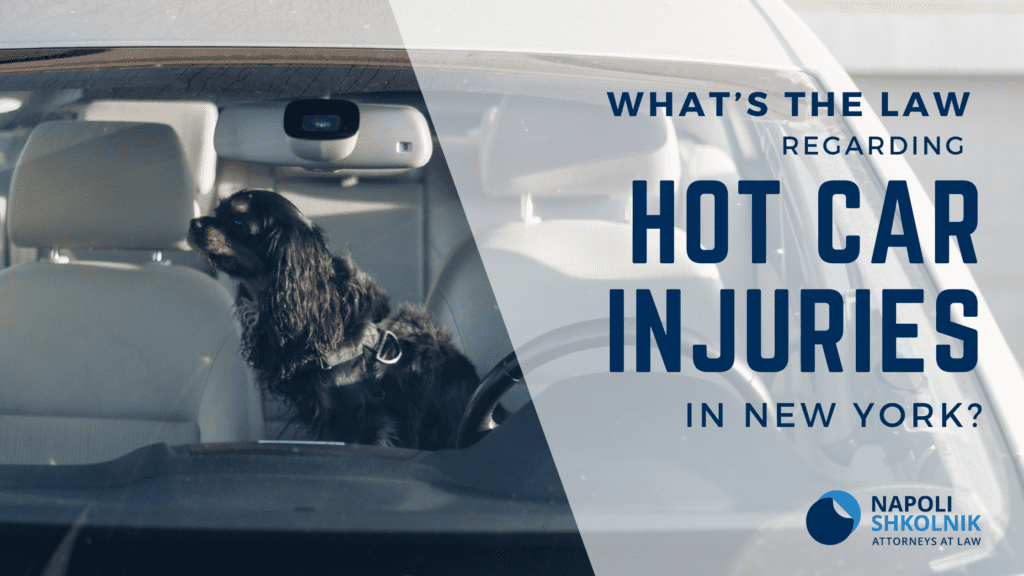
On a 90 degree day, after just thirty minutes, a car’s internal temperature reaches 120 degrees, even if the window is cracked. At that level, the body easily reaches heatstroke levels (104 degrees for people and 105 degrees for dogs, since their normal body temperature is a little higher). All states have civil and criminal laws that protect victims and hold tortfeasors (negligent actors) responsible for injuries. These laws vary significantly in different jurisdictions.
High body temperature is just one effect of heatstroke. Once the body’s temperature reaches heatstroke levels, it cannot regulate its own temperature. Therefore, without immediate relief, there’s no telling how high the body’s temperature could go. Any treatment delay means that heatstroke could be fatal. A New York personal injury lawyer holds people who negligently keep people or pets in hot cars responsible for the injuries they cause.
Criminal Law/People
Since 1998, ten New York children have died in hot cars after suffering Pediatric Vehicular Heatstroke (PVH). Many others have been seriously injured.
If a child is injured but survives, authorities could press first or second-degree reckless endangerment charges. First-degree reckless endangerment is a felony with a range of punishment between two and seven years in prison. Probation usually isn’t available in these cases. In addition to a reckless injury, prosecutors must prove, beyond a reasonable doubt, depraved indifference to human life. Depraved indifference doesn’t just mean a grossly unreasonable risk. Instead, s/he does not care how the risk turns out.
Second-degree reckless endangerment doesn’t have a depraved indifference element, so the punishment is lower. The state usually presses these charges if the injury wasn’t as severe or there was no evidence of malice or other extreme circumstances, like drug or alcohol use.
In fatal PVH cases, prosecutors could file murder or (more likely) manslaughter charges. Murder requires proof of malicious intent, as opposed to a reckless disregard for human life.
Can you break into a hot car to save a child? Not in New York. The Empire State has a very limited Good Samaritan law. People who damage vehicles to rescue people could face jail time as well as civil liability. They can only call 9-1-1.
Criminal Law/Animals
There’s no special Good Samaritan law for animals. In fact, in many cases, people can’t immediately call 9-1-1 in these situations. Instead, they must first try to locate the owner or at least inform other people in the area (e.g. go into a store and ask if anyone left a dog in a car).
Owners who leave animals in hot cars could face animal cruelty charges, but the more likely charge is Penal Law § 355 (abandonment).
Civil Law/People
If someone left a child or any other person in a hot car, New York personal injury lawyers can obtain compensation if they prove negligence, or a lack of care, by a preponderance of the evidence, or more likely than not.
Usually, vehicle owners have a duty of reasonable care to ensure that their passengers are safe and secure. The law requires them to ensure the environment is safe and also frequently inspect the environment. Leaving someone in a hot car, especially for more than two or three minutes, clearly breaches this duty of care.
Evidence in a negligence case usually includes witness statements and medical bills. Witnesses often testify that they saw the owner at work or shopping, seemingly unconcerned about a person in the car. Medical bills attest to the extent of injury.
Compensation in a personal injury matter usually includes money for economic losses, such as medical bills, and no economic losses, such as pain and suffering. Additional punitive damages may be available in extreme cases.
Civil Law/Animals
The same negligence/proof issues apply if the victim was an animal. However, in most cases, the law sharply limits damages in these cases. Usually, recovery is limited to the animal’s economic value, which in most cases is practically nothing. Additional compensation is available if the animal was a pure breed or a performance animal. In fact, if the animal was a performance animal, compensation for future lost income is usually available as well.
This rule is beginning to change. A few courts in a few jurisdictions have allowed owners to recover the noneconomic value of their animals, which is usually considerable. However, higher courts haven’t acted, and neither has the state legislature.
Laws in the Empire State offer limited protection to people and animals in hot cars. For a free consultation with an experienced personal injury lawyer in New York, contact Napoli Shkolnik.